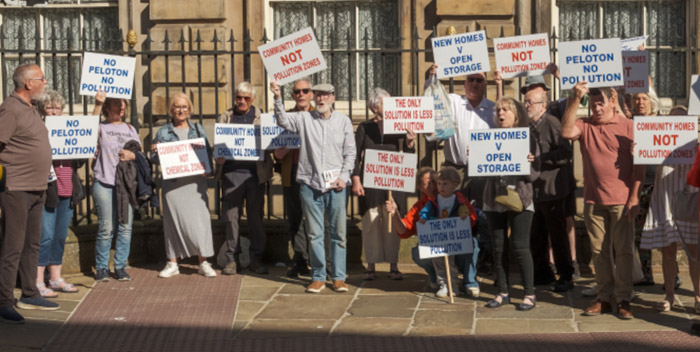
Photo above – L19 Campaigners outside Liverpool Town Hall in May. Image Skwarkbox
Peloton is a lesson in how planners and real estate companies have utter contempt for ordinary people.
By Ritchie Hunter
When Peloton Real Estate paid £4m for a piece of derelict land, left over from the industrial past of Garston, they thought their plan to develop it was going to be like a “Walk in the Park”.*
They failed, however, to take account of local residents, their hopes, their aspirations and their knowledge. The company view these people only as ‘Receptors’! A dehumanising term used in their planning documents.
Far from just being receptive bodies however, the residents are proactive, and have combined to voice their concerns; they are forceful and have stopped Peloton in its tracks. They see this development as one more imposition added to a list as long as an articulated lorry. They are sick of breathing in toxic fumes (from traffic and the Veolia chemical plant) or dust (from the docks), of getting battered by noise or shaken up by vibration.
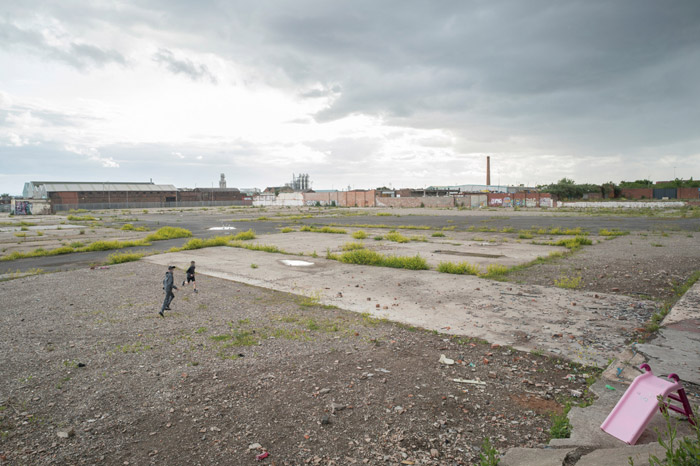 The Peloton site looking from York St. towards Veolia. Image John Davies
Peloton’s plan, a massive open storage site, is a long way from what was promised for the area only 10 years ago as part of a:
“…green, well connected neighbourhood. This will be achieved through the creation of two major new areas of open space at Dingle Bank and on Banks Road, as well as a new cycle route connecting Liverpool South Parkway with the Blackburne Street employment areas and Speke Garston Coastal Reserve.” Garston Village Masterplan
On the back of this ‘Regeneration’ a housing estate was built in Garston ‘Under the Bridge’, (and houses are still going up). One plan for homes however, on the site of a former industrial estate, failed to make it to the building stage when the company involved went bust.
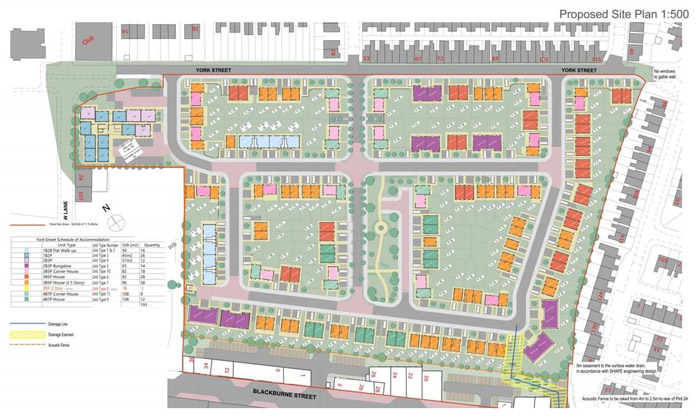 Site plan (submitted in October 2020)
What this land is to be used for is now in dispute. The community want housing, open green space, or even a sports and leisure facility. Speculators however see an investment opportunity as part of the Liverpool Freeport Zone.
In May the L19 Campaign Group (Garston Community United) persuaded Liverpool Councillors to overturn a recommendation by their own planning department to allow the land to be used for open storage. The company then appealed to the Secretary of State and now there is to be a Public Inquiry, starting on 10 November.
Peloton’s main argument is that the Council’s Air Quality Officer recommended their Air Quality Assessment (AQA). But this assessment appears to have been created by someone from behind the safety of a keyboard. It’s only an update of the AQA used for the previous housing plan on the same site! And, it doesn’t take into account assessments created for the expansion of Veolia, situated opposite.
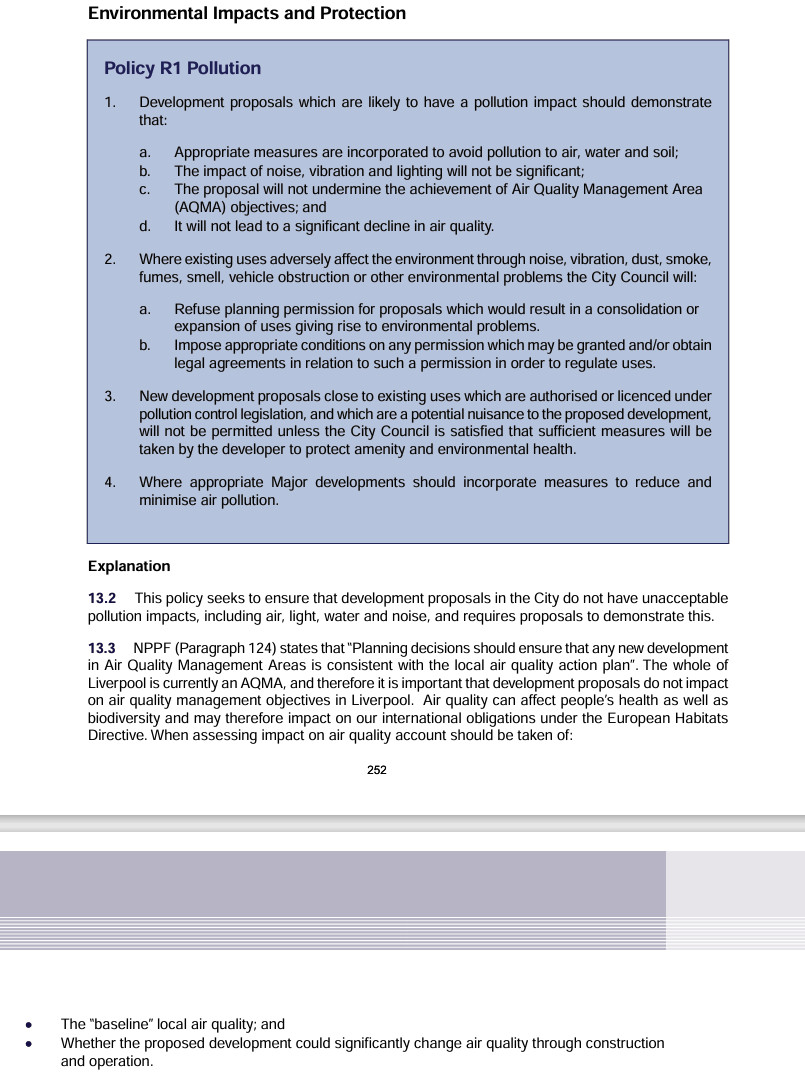
The Campaign Group say that this in itself is enough to have the Peloton appeal thrown out by the Secretary of State, because it is a direct breach of the mandatory government guidance on “the cumulative impacts from individual sites in local areas” as laid down in the National Planning Policy Framework. (for instance page 57) It is also against Liverpool’s own policy on pollution in the Liverpool Local Plan.
But the main point is that the:
Recommendation to approve Peloton’s plan by Liverpool Council Planning Department was based on inaccurate information and doesn’t take account of the cumulative effects of all the pollution.
How did the Planning Department come to miss this clear information? Was it a genuine mistake? Everyone knows that Councils are under-resourced and under-pressure to quickly push through planning applications, which may put economic considerations above those of safety. For some public bodies, such as the Environment Agency, there is even something called the ‘Growth Duty’.**
It has come to light, though, that Council Planners and Environmental Officers had meetings with the company without keeping any records of what was agreed. This is shown in an answer to a Freedom of Information request.
These undocumented meetings were at a time when Commissioners were still camped in Council offices drawing their huge salaries.
Contrast the close relationship of the Planning Department to developers, with the dismissive way that residents are treated. One complaint to Environmental Health, about the intense night-time light from Veolia, was met with the comment: “You need to get longer curtains”.
People in Garston, caught in the middle of political manoeuvrings and the re-industrialisation of their neighbourhood, are fighting back against threats to their quality of life. They are organising to make their voices heard at the Public Inquiry. They will refuse to allow Peloton, with the seeming help of Liverpool Council Planning Department, to bring more pollution to their area.
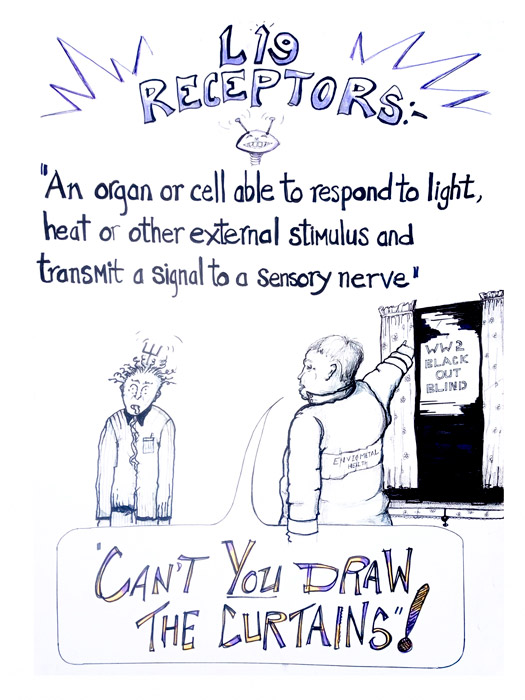 Local People are not real in this plan, they’re ‘receptors’. Image by Meryl Kelbrick
Footnotes:
*Said by a Peloton representative.
** The so-called “growth duty” was introduced into law in the deregulation Act 2015. The growth duty requires all UK regulators to “have regard to the desirability of promoting economic growth”.